
Season 2: Episode 1
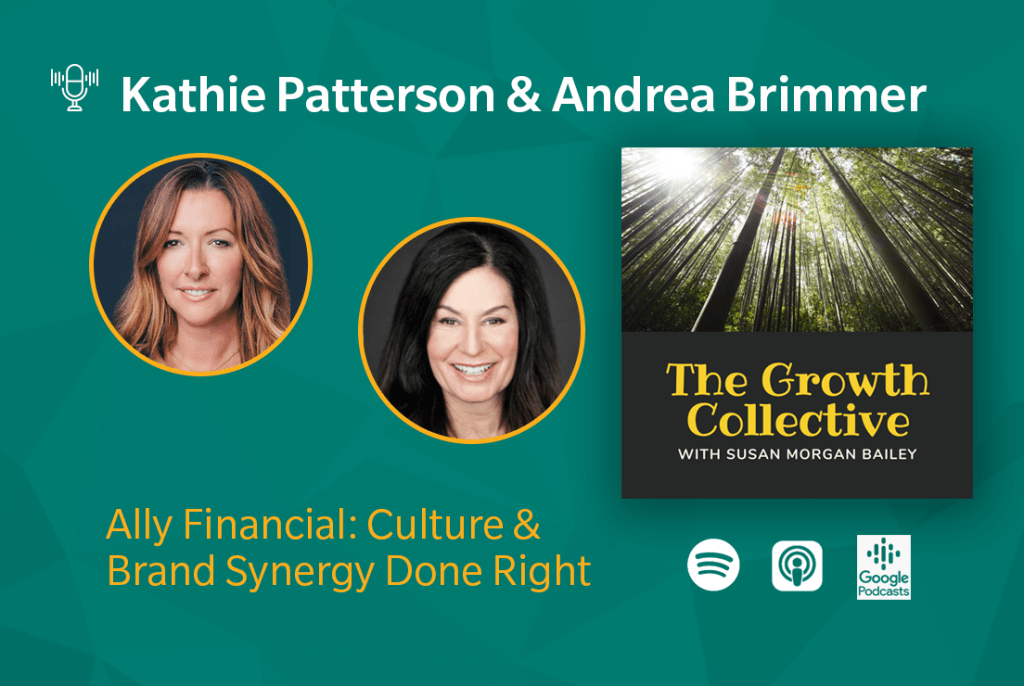
Ally Financial: Culture & Brand Synergy Done Right
Susan Morgan Bailey:
Hi, welcome to The Growth Collective podcast. My name is Susan Morgan Bailey. Each day, I put my superhero powers to work as the culture and well-being practice leader at Marsh & McLennan Agency Michigan, the proud sponsor of this podcast. I believe it is possible and essential to take great care of employees and doing that is key to building a successful and thriving business long-term. I’m here to help you believe too, through interviews with executives and practitioners who through trial, error, and experience have come to understand the power of culture on people and its impact on the bottom line. Each episode will focus on the lessons learned and steps you can take to lead change and grow a healthy culture of your own. Thank you for joining me today. Let’s dive in.
One way of thinking about culture is to think of it as the personality of the organization. Is it a nurturing and caregiving culture or a revolutionary and innovative culture? Or maybe it’s both. The external facing brand of an organization is similar. It’s the personality of the organization that comes through in marketing efforts that help customers connect and build trust with the brand, comes through in the way it treats customers and in the products it delivers.
I’m simplifying, but you get the idea. Cultures and brands are like personalities and when the internal and external, the culture and the brand are aligned, they feed each other. My guests for this episode are Kathie Patterson and Andrea Brimmer from Ally Financial. Kathie and I met years ago when we worked together at DTE Energy in Detroit. Kathie Patterson is now the chief human resources officer of Ally Financial. In this role, she is responsible for overseeing the company’s human capital, talent management, compensation, benefits, well-being, internal communications and culture efforts, ensuring they support the organization’s overall strategic objectives and drive Ally’s efforts to be a leading employer of choice.
Andrea Brimmer is the chief marketing and public relations officer at Ally Financial, where she leads a team dedicated to disruptive marketing that connects with consumers and their values. Under her leadership, Ally introduced its do it right brand promise in 2016, focused on unifying all of the company’s businesses under one mantra. Since then, Ally’s brand has doubled in value every year. Her team debuted at number seven in the annual Ad Age Marketers of the Year in 2019 and she was recently named a 2020 Brand Genius by Adweek.
Do It Right highlights Ally’s unique focus on doing the right thing for customers. The campaign not only aligned the full scope of the company’s product offerings under one mantra, it also reflected the company’s internal culture and core values. Since the Do It Right promise was launched, it has become a point of pride for Ally and resulted in the highest consumer brand sentiment and awareness in company history. I’m excited to share this episode with you. It’s an extraordinary highlight of the symbiotic relationship that’s where two things in a relationship have mutual benefit and no harm of culture and brand and the magic that can happen when an organization has clarity about who they are and take steps to bring their personality to life through culture and brand. Let’s jump in.
Thank you ladies for joining me on this first episode of 2021. I feel kind of bad for 2021. I feel like it has a lot of pressure on it to be extraordinary in comparison to 2020. But a lot of good things came out of 2020 and we’re going to talk a little bit about that today despite the fact that it was awfully challenging. Before we go there, I wanted to introduce the two individuals who are with me on the podcast.
I’ve got two people I know in different ways joining me today. I have Kathie Patterson who leads HR for Ally. And I have Andrea Brimmer who leads marketing for Ally. But my descriptions do no justice. So if we can start with Kathie and you can talk a little bit about you and your role at Ally, that would be great.
Kathie Patterson:
Great. Well, thank you, Susan. Thank you for inviting both of us today. Kathie Patterson, I am the chief human resource officer at Ally Financial. I’ve been with Ally for, hard to believe, 13 years and have been sitting in the chair for the last four years. I am responsible for the human capital strategy so that is hiring employees, rewarding them, developing them, as well as responsibility for internal communication. So I look forward to sharing the Ally story with you today.
Susan Morgan Bailey:
And Andrea, how about you?
Andrea Brimmer:
Susan, I echo Kathie’s comments and thank you for having us on this morning. We’re excited to be with you. I am Andrea Brimmer. I’m the chief marketing and PR officer at Ally. I’ve been here also for about 13 years. Kathie and I both joined right when Ally was transitioning into new brand. In fact, my first assignment when I came to the company was create the new brand, create the go to market strategy and really help develop what is now our lead culture.
Andrea Brimmer:
My team has responsibility for all things brand and marketing as well as everything that we do from an external communication standpoint and prior to coming to Ally, I spent about 20 years on the agency side leading the Chevrolet account.
Susan Morgan Bailey:
Well, I’m excited to have you here. I heard PR, marketing, communications, human resources. Actually, human capital. All of those go together, and my hope is by the end of this discussion, everybody will understand that in a new way. So one thing though I think that’s helpful because especially two of you have been with the organization for 13 years. 13 is my lucky number. So this is going to be a good chat. But I think it’s helpful for people to understand a little bit about you in terms of what brought you to where you are today.
Susan Morgan Bailey:
I mean, when you think about the circumstance you were in, you both walked into an organization that was becoming what it is today. And with that, you individually as humans brought experience to that, brought knowledge, lessons learned. So can we go back in time a little bit whether it’s 13 years, four years for you, Kathie at some point when you’re in that role when you said, “You know what, I’ve been there. I’ve done that.” And this time, this is what I’m bringing to this that’s going to be unique or different. It’s sort of that origin story element that you brought to the work you did over the last 13 years.
Andrea Brimmer:
I can start if you want, Susan. As I mentioned, I went to Michigan State. I was a college athlete. I played soccer at Michigan State and I was part of the first ever women’s varsity team up there. And I think that was actually where I got my start in terms of understanding how to pull people together to make change, because when I went up to Michigan State, it was a club team and we felt very strongly that the team needed to get varsity status.
Andrea Brimmer:
So we worked together as a team to petition the athletic board and ultimately achieve our varsity status. Then we actually went and did exhibition games and did lobbying on behalf of other women’s teams all throughout the Big Ten to make sure that all of the teams in the Big Ten could achieve a varsity status. It was foundational learning that I’ve carried forward through really my whole life around that idea of standing on the right side of right, and what you have to do to participate in the fight, if you will.
Andrea Brimmer:
When I graduated you know with an advertising degree from Michigan State, I worked at Cambell-Ewald for 20 years and I learned a lot about the advertising business and the marketing business, and about the DNA of a big brand and the importance of that DNA. You look at a brand like Chevrolet, so much of the advertising was intertwined with what that brand stood for, for years whether it was iconic campaigns like Heartbeat of America or like a rock to the things that Chevy did to show up as part of the American landscape.
Andrea Brimmer:
When the opportunity presented itself to come to what was then GMAC, and create this company, almost 100-year-old brand. And what we said at the time is, “This is a really unique opportunity to take 100-year-old startup, if you will and create something new from the ground up.”
Andrea Brimmer:
I couldn’t pass up the opportunity to do that. It was so exciting on so many different levels and we were launching in the midst of the worst financial crisis since the great depression. So the ability to solve for customer pain points, and like I said be on the right side of right and change the landscape of financial services, which had largely been unchanged for over 120 years was a really unbelievable opportunity. That’s what drew me and really that’s what’s fueled me in terms of the path forward even 13 years later, which is this notion of how do we continue to do things the right way?
Susan Morgan Bailey:
So was that around the time that you became Ally as a name at that time?
Andrea Brimmer:
Yeah, absolutely. So we were still GMAC when I came and like I said my first assignment was work with a small team to create the new name. Create what the company’s name is going to be, what it will look like, what the manifestation of it will be in the marketplace. What the go-to market strategy would be. So we really created this thing from the ground up and it was an unbelievable opportunity to just draw on all of my past experiences to be able to be challenged to do something that I had never done before, which is create a brand from the ground up. So it was an unbelievable opportunity, and I think that’s what excites us today is to see the maturation of the company, but to know we’ve got so much more work to do to continue forward.
Susan Morgan Bailey:
I love that background. I appreciate that. So brand and marketing, it’s got its go-forward strategy and then there’s the human capital side of things. And you guys were just off in a corner not paying attention, right? Just kidding. So talk about the 13 years for you, from your perspective on the human capital side.
Kathie Patterson:
So similar to Andrea, my background is psychology. So I started off in engineering and, Susan, it was only maybe one semester when I realized that I was in over my head and it wasn’t the right field. I was drawn to psychology and I have always been curious about human behavior, social psychology, how we as humans show up and act when we’re within a group.
Kathie Patterson:
So that led me into industrial organizational psychology. I’ve been in human resources now for over 20 some years, which is hard to believe. But I think the draw for me at that time was about helping employees learn their natural talents, help employees find work that is meaningful. You spend too much time of your day and your life in the workplace. So what can you do to find work that is meaningful.
Kathie Patterson:
When I look back, it was always around helping individuals learn about their natural talents, looking for how to lift and how to maximize employees. But it’s probably since I’ve joined Ally and assumed this chair in the last four years that I have a deeper appreciation and an understanding that it’s not just about the meaningful work, but how do you draw that connection to somebody from a personal standpoint. How do you create a sense of belonging, a community that employees want to be a part of? How do you create an environment where employees feel like they can show up their whole self?
Kathie Patterson:
So really, the focus now has been, how do you take and draw professional connections to personal connections, allowing people to find their purpose through the work in which they engage in? And really drawing that that lineage so you can create that engagement and that that sense of community.
Kathie Patterson:
So the other mission for me since I’ve been in the chair has been how do you bring back the human in human resources? I mean so much of human resources is about policies, programs and I think over the years, it’s been easy to hide behind compliance related regulatory requirements, legal requirements as opposed to really stepping back and thinking about that care factor and how do you start really bringing back the human in human resources? So that’s a little bit of my story and probably what fuels me every day when I come to work.
Susan Morgan Bailey:
There’s a lot there. We’re going to unpack all of this over the next 45 minutes or so. But one of the things as I was thinking about it is, we may have individuals and I hit it in the intro, but I’d like to hear it from your perspective because you brought up purpose, and we brought up brand, and meaning. You are an organization that provides in its truest, purest sense, Ally does what?
Andrea Brimmer:
Well, I would tell you that… And our CEO says this all the time, JB, he says, “What we do matters.” Right? If you think about, probably the three most important things in your life, it’s your health, your family, and your money. And your money not in terms of what it can buy you, but what it can empower you to do in your life and what it can empower you to do for the people that are important for you in your life. And we’re a financial services company, right? But we’re a digital financial services company. We constructed something very, very different.
Andrea Brimmer:
So we’re entrusted with people’s money every single day. And we have the firm belief that it’s your money. If you save it well, you can spend it well on whatever you want. And we have a role in that. So that’s what we do. That’s what Ally does, right? We lend money. We help you save money. We help you buy a home. We help you buy a car. We help you invest wisely.
Andrea Brimmer:
The name Ally was purposely chosen to be literal as well as figurative. The literal meaning of having somebody in your corner was something that we felt was missing for far too long in financial services and that we had this massive opportunity to truly be in people’s corner. So that’s what we do. We’re your financial Ally. That’s the focus of what we do in everything that we’re driven to do.
Susan Morgan Bailey:
It’s interesting. So many organizations have a hard time getting beyond the basics of in creatively thinking about how they make a difference in the world, and you’ve done that. And maybe not even creatively, you’ve just done it genuinely. This is how we make a difference in the world. I’m curious how the brand… How you see the brand values reflecting back internally, Kathie? I mean, does that impact the way you think and approach the work that you lead?
Kathie Patterson:
Oh, absolutely. Andrea has put out there a very lofty promise to our customers of do it right. And in order to do it right, I mean you need to have that mindset driven across the workforce. We need to have relentless allies that are obsessing over our customer. So that brand line sort of serves as the mantra for everything we do in the organization. It’s the culture. It’s the mindset that we want to permeate the way in which we approach and do work. It also served as the starting point for us shaping our employee value proposition.
Susan Morgan Bailey:
So what does it mean to do it right for our employees? What does it mean to do it right for our communities? What does it mean to do it right for our customers? So there is no doubt that that brand promise needs to be backed up by a culture that bleeds it. They bleed purple. They feel it, and that’s what they’re committed to do.
Andrea Brimmer:
Then I would tell you, when we launched, Do It Right, I spent six years now, since we launched that tagline, which is crazy. The whole meaning behind it was the golden rule, do unto others as you would want them to yourself. And not only is it one of our brand pillars, but the manifestation of that brand pillar became the tagline. And what Kathie and I did is we got on the road together. We literally went out to every one of our corporate offices, our regional satellite offices and we presented together. We presented the campaign. We presented the tagline, but we also talked about the human capital aspect of it and how important it was to Kathie’s point that I couldn’t be out there saying, Do It Right in our advertising if we didn’t uphold that in literally every single thing that we did.
Andrea Brimmer:
It manifested itself in that I think our employee base saw the reciprocity between their role in Do It Right and the support of human resources behind the brand promise that we were going to make externally, even to the point where we changed our evaluation system so that we’re holding people up around how they do it right, and we’re awarding and rewarding people on that basis. So you can’t just have a tagline like that and not infuse it in literally every aspect of the human capital side of the business.
Susan Morgan Bailey:
Is that it? Do It Right, is that the driver for all of your human capital approach or are there more elements of it? I’m curious because there are organizations I can think of that haven’t even figured out one way of thinking about how they approach it, let alone multiple guide posts or guiding principles. Kathie is there more to it or does Do It Right permeate throughout and then that’s your way of approaching everything you do with your humans?
Kathie Patterson:
We’ve tried to keep it simple. So Do It Right is the tagline, but we do have a set of core values of what the expectation is as it relates to professionalism, what the expectation is as it relates to obsessing over the customers. I think what we’ve done is we haven’t overwhelmed the organization with 50 or 60 different competencies or descriptors. I think it’s pretty simple in the spirit of Do It Right. How are you relentless? How are you a relentless ally? How are you obsessing over the customer? How are you giving back to your community? I think we have some high level sort of post that we put in the ground, but for the most part, we try to keep it simple so it resonates.
Susan Morgan Bailey:
I like that. It’s interesting to hear the words obsessing over the customers, relentlessly because if I were to look from the outside in, which is one of my favorite side hobbies to do, at your organization, and make a guess at how you treat your people on what you think about the value of those who work for the organization. I would probably use obsessing over your people in a very positive way this year. I mean, I’ve seen… If I use LinkedIn as a gauge, I’ve seen a ton of posts from both your regular employees, not executives and managers, just anybody in the organization to some of the post that you’ve shared, Kathie, to I have a friend who works for your organization and has been there less than two years, so she’s got fresh perspective.
Susan Morgan Bailey:
And all of it is ringing with this idea that you care deeply about the well-being of the individuals in the organization and believe that it’s key to the success of the organization. So with that lead in, can you talk a little bit about, was that how it always was or did 2020 shift things or amplify things? What happened this year for you?
Kathie Patterson:
I think, well, for starters, no. I don’t think it was unique to this year. There was no doubt that our values were sort of tested and we needed to show up with deeds. But as it relates to our culture, I mean we have a CEO and we have a senior leadership team that fully understands that our culture is really our competitive advantage. If you think about it being in the financial industry, what sets us apart beyond maybe our rates here and there is really about our people.
Kathie Patterson:
So our culture was clear. When this 2020 hit in terms of the craziness that between the pandemic and social unrest, there was a clear alignment amongst the leadership team in terms of what the priorities are. When it came to the pandemic, you knew very clearly that it was about the health and safety. We aligned and moved out rather quickly in terms of ensuring that we provided the right level of support.
Kathie Patterson:
And as for the social unrest, it took a very similar action. We knew that our employees were hurting. How could we create containers for employees to come together and sort of talk about their personal experiences so we can all collectively grow? So I think this year, probably demonstrated to our employees that these weren’t just words. We backed it up with clear actions and we did it rather quickly. We were quick to and swift to sort of jump into action, because we all knew what was important and there was no debate in it.
Andrea Brimmer:
I think the greatness is tested in duress. I think that the culture, it was easy as a leadership team to do the things that were done this year for our employee base because it was such an integral part of our values that it manifested itself rather easily where I think there are probably a lot of companies that had to debate for some time what to do both for the employee base and for the customers. If you look at what we did for our customer base, we offered the most comprehensive forbearance package in the industry within a week of the pandemic really accelerating.
Andrea Brimmer:
Four months of no car payments. Four months of no mortgage payments, waived all fees for our customers. And even if you needed a debit card overnighted to you, we put that on us, made customers whole. If you had a negative balance in one of your accounts with us, we gifted you that money, so that if you were going to get a stimulus check, you got the totality of that stimulus check. Those are just things that… And we made it easy. You didn’t have to call us and beg, and tell us why you needed this. You simply went online, checked a box and said, “I want the forbearance,” and that was it.
Andrea Brimmer:
Kathie used the word deeds. We have this big saying around deeds, not words. That’s when you really see what companies are made of. That’s when you see what brands are made of. That’s when you see what cultures are made of. And because we as an organization took care of our employees, it was really easy to do the right thing for the customers.
Susan Morgan Bailey:
I love those examples and I know a lot of people who listen to the podcast are looking for ideas in terms of both what could I do differently and or what did you do so that I can hear that you did it, so that I can convince my team that that is the right thing to do. So you gave some examples with the customers. Kathie, can you talk about like, let’s start with well-being? I mean, what are some of the things that you’re proud of or you think were really impactful when the craziness of 2020 hit. I know you had a well-being strategy that was well ingrained before that, but what if anything changed? What did you amplify? What were some of the things that you stepped into?
Kathie Patterson:
I think the one thing Susan that we did fairly well this year is we were pretty attuned to where our employees were, and what they were experiencing, and tried to do our best to meet them where they’re at and provide support. Some illustrations is on the onset, employees were extremely concerned that if they were to contract COVID, what would that mean for their healthcare and what would that mean for their leave? Would it trigger disability? How would they cover their PTO bank? So we were very quick to alter our benefit plans to ensure 100% coverage for COVID.
Kathie Patterson:
We were very quick to change our leave policy in relation to the waiting period before someone goes on disability. We also recognize that at this particular time we have a lot of employees that are very dependent on two incomes. And if somebody loses a spouse or a family member loses their employment, which the unemployment rate skyrocketed, second quarter, we looked at how we could provide a level of hardship assistance. So we gave $1,200 stipend to employees earning below 100,000 to help them during this window of time.
Kathie Patterson:
We’ve also pulled ahead a portion of our bonus to assist as well mid-year. So we’ve looked for financial ways that we can help our employees. We’ve also recognized that many are right now homeschooling their kids. So a series of online tools, partnerships that can help as it relates to providing support within school systems as well as extending our plans for child care stipends. So those are some of the things that we’ve done as it relates to the health and welfare changes, but for the most part, I would say the part that we have afforded our employees probably most is a level of flexibility and helping them understand that we get it. Their life is completely blurred and work with your local management and we will figure out what we can do to provide the right level of support for you.
Andrea Brimmer:
Yeah. Susan, I would add one thing that’s really, I think speaks to the heart of Ally. We established an employee relief fund that was entirely funded by our associate base. So people basically could contribute to it to help their teammates that were suffering financial hardship and then people at Ally could apply for a grant from the relief fund. It was incredible to see the amount of people that donated the amount that funneled into that relief fund. And then I think people were just extremely touched by the needs of so many across the organization.
Andrea Brimmer:
It’s the character of Ally that comes through time and time again. I feel like that tone, it’s set every single day from the top. And the other thing that I think was really unique this year is JB, who’s our CEO, did a video message. Every week, week after week after week, from his home, on his phone, that he sent out to the employee base just talking to people and communicating with everybody. That was something he didn’t do in a normal year. We’d have town halls or other things, but just that interaction between JB and people knowing that he was going through the same thing and that he cared and that the entire leadership team was focused and he celebrated the bright side in every one of those messages. I think he got a lot of people through a really, really tough year.
Kathie Patterson:
The other thing that I would highlight, Susan that I neglected to mention earlier is we have eight employee resource group, and they would come together on an ad hoc matter just to provide support to each other. So throughout this year, you have these employee resource groups pulling together the members, just in the spirit of checking in, how are you doing? Are you okay? And the one example that jumps out at me in terms of providing support is it’s very common for veterans to suffer anxiety, depression, PTSD.
Kathie Patterson:
So during this window of time where many of us are working from home or living alone, there’s this level of loneliness that kicks in or depression and mental health being a concern. Our veteran’s ERG did a call tree. So reaching out to others and just checking in and engaging. It created a connective community throughout the organization of just pure concern.
Susan Morgan Bailey:
Along those lines, your ERGs, building upon that and tying it to the social unrest element, I know many organizations dug in into territory that for some of them was new. Can you talk a little bit about that experience. Again, was this something you were already addressing or did 2020 open some doors that previously weren’t open?
Kathie Patterson:
We’ve had a strong focus on DNA for the last four or five years. And I think we have close to about 40% of our organization that participates in employee resource group. I think we’ve done a lot as it relates to building awareness education as it relates to each one of those resource groups needs. This year, I think there’s been a sharper focus as it relates to black and brown issues, challenges the wealth gap. So we had the right foundation to sort of quickly sort of assemble and come together as an organization, but it had a different feel.
Kathie Patterson:
As soon as everything happened after the George Floyd killing, we had close to 4,000 employees come together as part of a Let’s Talk About It series. The emotions were raw, but it was an opportunity for employees to talk about their personal experience. Each one had a little different flavor, a different feel, but there’s no doubt that it has sharpened our focus in terms of things we need to do to lift our brown and black associates and really look at what we can do to make sure that we’re providing the right level of support.
Andrea Brimmer:
Yeah. I would also say that that manifested itself externally as well in a number of ways. I mean, like so many companies, we were very swift to put out a very strong statement around racial injustice right after the George Floyd killing. But in addition to that, we took a little bit of a different tact from a marketing perspective. You may have heard about a lot of companies doing the Facebook boycott. We kind of looked at the tenants of that Facebook boycott and decided just adding our name to a list of a million other companies that are boycotting Facebook doesn’t make a lot of sense for us. Instead, let’s dig in and let’s have candid conversations in social media around the financial services industry’s role in racial injustice.
Andrea Brimmer:
We took on some hard issues in social media. We talked about redlining, what it means, why it’s occurred for so many years and what we will do to ensure it doesn’t happen. We took on availability of credit to black and brown people of color and why the industry has historically done it, and what we would do to ensure that we’re part of the solution going forward. We’ve focused on creators in the space that are both black and brown in a variety of different industries, and what we can do to help empower those creators.
Andrea Brimmer:
So we really decided to dig in and let’s take a real mea culpa as an industry and talk about what we’ve done as a financial services industry to further racial injustice and how we’re going to be part of the solution going forward. So I think those are just small examples of things that we’ve really done to sharpen our focus this year and take on some hard conversations.
Susan Morgan Bailey:
Yeah, small but huge. Because besides I mean, when you talked about that, I mean, what Ben & Jerry’s did an incredible job addressing it, but they didn’t necessarily play a role historically in that. So I think that’s extraordinary that you all went there. I want to play off of that the work that many organizations did, the work that you did this year and amplified played a role in the ability of your team members to survive and thrive. I don’t like to talk about surviving because it feels negative in a way, but there is a part of this where there are folks who really are in survival mode. But what we want them to be is in thriving mode.
Susan Morgan Bailey:
When you think about it, the work that the marketing did was externally focused on community. Kathie, you’re focused on your internal community, but your folks have focus externally connected to community. It plays a role in everything you could do. So can you talk about team member thriving, community thriving, how you see that going together, and why does it matter to the company? I mean who cares if they’re thriving? I’m kidding. Tell me why that matters to Ally.
Andrea Brimmer:
I would say in terms of why it matters, we have this deep commitment that we serve through deeds again, not just words that we need to be active participants in the communities in which we live and work. We do, I would say demonstrable thing. For example, moving 1,700 people to downtown Detroit and signing a 17-year lease at the Ally Detroit Center because we felt like it was incredibly important to be a part of the re-gentrification and the evolution of the city of Detroit. Things like holding a PGA golf tournament in Grand Blanc, Michigan at Warwick Hills when the PGA told us, it’ll never draw because we felt like we had to help the Flint and surrounding communities as one of Southeast Michigan’s largest employers.
Andrea Brimmer:
Those are two examples, just in Michigan, but you could go on and on and on in all of the places where we have corporate centers and regional business offices, because you can’t separate where your company sits from the responsibility that you have to make the communities in which you live and play, and work, and thrive. And that’s important to our employee base. We always say, “We can’t write the biggest check. There’s going to be a lot of companies that are going to write way bigger checks than we are in terms of community giving, but we will out heart everybody.”
Andrea Brimmer:
You see our people show up in numbers when it comes to volunteering even in a year like this year, just incredible amounts of people just showing up to whether it’s mentor kids, whether it’s to wrap gifts, whether it’s to adopt families, whether it’s to help shelter pets. I mean, you name it. The list just goes on and on and on. It’s absolutely incredible. And that emanates from the culture that we’ve built which is around this idea that we have a platform that’s powerful and we have to use it. And if not, it’s wasted.
Susan Morgan Bailey:
I like that example. Kathie, what are your thoughts on community from your perspective?
Kathie Patterson:
I echo, Andrea’s point wholeheartedly. First of all, it is core to who we are as a company. It’s at the foundation. We want to give back and do right in the communities in which we serve. And our employees have the same desire. The view that employees want an integrated life. Most of our lives are a little sloppy. There is a real desire to want to be able to have to be part of something that’s bigger than yourself as well. So to be able to draw that intersection for our employees, I think is what makes us special. It’s drawing that personal connection. That’s what I think makes Ally special is it’s not just about your professional work that you’re doing, it’s about connecting with them on a human level and the expectation that we give back, and our employees feel better. And it’s who they want to be.
Susan Morgan Bailey:
At the top you talked about purpose and meaning, and I feel like there’s themes of that related to this. Do they go together? Does everybody in the organization have an expectation that they’ll know what their purpose is in life or do you facilitate that? How does that come to life in the organization and does it connect to this?
Kathie Patterson:
I love to say that we’ve solved that. I would love to say we have that. I do think our wellness platform does provide for a series of tools to really help employees gain a little bit greater insight in terms of their work and where the meaning comes from. But as a company, we believe it’s our purpose to give back. In order to demonstrate our commitment, every employee gets eight hours of volunteer time off to donate their time or devote their efforts to supporting something within their communities.
Kathie Patterson:
We have tried to do everything we can just to make sure that it’s a little bit easier for our employees to give back, our employee resource groups organize as Andrea said a series of those sort of external facing events to allow us to make a difference.
Andrea Brimmer:
We were born out of necessity, right? When we launched… As I mentioned, we launched in the middle of the worst financial crisis since the great depression. People hated the banking industry. If you think about the temperature of the country back then, I mean, it was red hot against this industry. There was something very empowering around solving for pain points that existed in the industry and knowing that we changed the landscape of this industry forever. And that fuels people at Ally. That sense of purpose. I talk about this a lot externally. There are some companies that have a hard time understanding what their purpose is.
Andrea Brimmer:
While I would love to say every whale in the world should be saved, that’s not our purpose, right? We’re not about saving the whales. We are about helping people kind of do the right thing in their financial space. When you’re created out of purpose, it emanates through your actions. And I think that that’s something that you can’t separate. We didn’t just wake up and say, “Okay, purpose is important.” We were created out of purpose and people feel that. You don’t even really have to say it. It’s just something that’s intertwined in our culture and it fuels people to do the right thing.
Andrea Brimmer:
It’s hard to put your finger on it. You can ask your friend who works at Ally, “You just come here and you feel it and it’s part of the ethos of the company, it’s part of the expectation of the way that we hire people.” I think we look for people that have those values. When you surround yourself with a group of people that have those same values, it’s very easy to show up every single day in the communities where you live and work.
Susan Morgan Bailey:
As I’m hearing this, one of the things that comes up for me, my tendency when I do these interviews is to think about all the naysayers that I’ve talked to over the years. So one of the things that I’ve asked myself when I’ve worked with organizations, but rarely do I ask the organization because the opportunity isn’t always there, is ask the question, “Do you intend to be around for a long time?” Because my observation with some organizations is, they’re going to burn out. Because there is not an intentionality about culture and brand the way it is in your organization.
Susan Morgan Bailey:
I’m guessing you intend to be around for a long time and I’m guessing that you see culture and brand in the intersection and all of that. You say it’s natural and it’s part of the way that the organization is, but I imagine there was a fair amount of intentionality that created the space that you’re in today.
Andrea Brimmer:
One thing to underscore that, I think that’s really important, if you look at our measurable brand sentiment in the marketplace, the financial services industry average is in the low to mid 30s. That’s consumer sentiment towards their brand. Our brand sentiment is plus 90%, and at some points in this year, it went as high as 98%. It reflects more of the most admired companies in this country. I think that just demonstrates loudly how different we are as a brand especially in a category that is largely unliked.
Andrea Brimmer:
So that intentionality is there. Obviously, we fuel it every single solitary day. We talk about culture a lot. We talk about culture as a leadership team. We talk about culture within our groups that we lead. We talk about our role in culture. We talk about intersecting culture, all of those things. But again, I think that if you don’t have the platform that fuels it, you can talk about it all you want, but it doesn’t come naturally.
Andrea Brimmer:
Yeah, it does come naturally for us and I think we absolutely intend to be around for a long time. I think it’s why we chose a business model that’s digital financial services powered by this human touch so strongly and that’s really what has seen us have the most explosive growth really in our company history this year.
Kathie Patterson:
Susan, I’d also add to Andrea’s statement is that brand sentiment has created such a sense of pride amongst our employees, which fuels them even more. The humorous commercials, the clever sort of moguls in the making, those efforts have created such a pride, prideship and sense that our employees, I mean they want to refer other people to work to us. They want to tell the stories. They are our best marketers because they believe it, they feel it. And that’s powerful. I wish I could say that there’s a recipe for that. I think it’s exploded within our organization.
Susan Morgan Bailey:
Well, you hit upon where my next question which was, have your efforts impacted your ability to attract and retain talent and have you seen that evolve over the years?
Kathie Patterson:
So Susan, that’s where I think I’ve learned the power of having marketing as your right-hand person or working closely with. Andrea has been able to help us take our stories within the company and clearly demonstrate what our employee value proposition is out there to set the stage, which has helped us immensely as it relates to bringing in perspective, top talent. People are knocking on our doors because they want to be a part of that culture. They feel it in the communications, the marketing that we put out there. Andrea has been instrumental in helping us tell that story.
Susan Morgan Bailey:
Yeah, that’s… Yay. That example is the one that I haven’t directly promised it, but in the sense that I’ve said it. If you build it, they will come in the sense, but you need to create an intentional culture and you need to capture and tell the stories. You can’t just sort of sit over here and be awesome and not help people understand what that looks like, and it has to be through authentic real human communication that connects. So I love that you’ve figured out how to bring that to life.
Andrea Brimmer:
I mean, look, I have the joy of being able to tell the story, but the reason that we can tell the story so well is that it’s truisms, right? It exists within the organization. And there was a time not too long ago where, Kathie’s team would recruit and people would say, “Who? Who’s this calling? Ally? What are you? Or alley or what?” Today, that’s not the case anymore. We’ve hit a different level. I think it’s been not only through the stories that we’ve been able to tell, but it’s been through our deeds. Just the things that we’ve done.
Andrea Brimmer:
I talked about the forbearance package. For years we’ve done this program called Banksgiving where we just give our call center reps half a million dollars at the thanksgiving time frame and say, “Just surprise and delight customers.” And we capture that in film and we put that film out there. It’s programs like Moguls where we noticed that only 1% of venture-backed capitalist companies in the country are owned by black owners. Every year for the last two years we’ve been doing this Moguls program where we’ve been mentoring and giving young HBCU students the opportunity to pitch us and obtain both internships and jobs at Ally and make a real difference in the world.
Andrea Brimmer:
So our marketing, I think is a combination of stories well told, but actions that make meaningful difference that allow the brand to show up in very genuine and authentic ways. And that’s been a key differentiator for us.
Susan Morgan Bailey:
I love that. As we wrap, a couple questions. One, I’d be curious to hear each of you advice you would have for human resources folks in organizations where they listen to this and they say, “Oh my gosh, this would be amazing if my organization could get closer to what Ally has accomplished, from a brand and human capital perspective.” What is the first piece advice you have for an organization that isn’t where you are, maybe hasn’t figured out purpose or a way to attract and retain talent, they’re struggling? I know I’m giving you a really big question, but what’s the first piece that comes up for each of you? You want to start, Kathie?
Kathie Patterson:
Yeah. The first one is you need to make sure that your CEO supports it and sets the right tone. There is no doubt that it starts from the top. As much as I could put a pretty presentation together to talk about the employee value prop and start talking about why this is important to have a CEO sort of understand it and ingrain it, I think it starts there. I mean, JB is a huge advocate and a supporter, and this is a priority for him, which then has sort of permeated throughout the organization. So my best advice is to start at the top. Start at the top and really help demonstrate why it’s important to your organization.
Andrea Brimmer:
From my perspective… I echo obviously what Kathie says. JB is probably one of the only CEOs that when he sits with analysts, talks about culture, before he talks about anything else. And I think that that sets a tone and that makes a huge difference for us. But look, I think the one thing that people miss is the intersectionality between human capital and brand. Kathie and I have a very intentional relationship and our teams have a very intentional relationship. I have a team within my organization that is dedicated to employer marketing and that’s their sole focus, how to bring the story to life. How to tell the right story in terms of recruitment. How to develop and further the employee value proposition. How to work hand in glove with Kathie’s team on strategy. What to say in social media how to create the right impact?
Andrea Brimmer:
We work very closely together on programs like Moguls. That started as a marketing program, but quickly became a program that we have been strong partners on, that has created a pipeline of diverse candidates into Ally. So I think that oftentimes people don’t understand that there’s a role that human resources has around brand strategy and marketing and human resources have to work together on that strategy.
Andrea Brimmer:
I’m just fortunate because we have the best human resources officer in the country bar none. Make no mistake. I mean Kathie’s personal touch is what sets her apart. I always tell her. She cares more deeply about people than any human resources person I’ve ever worked with over the course of my 30-year career. That makes a huge difference. It’s not dots and check in the box for Kathie, it’s about what’s right for people. And I think when that tone is set out of your leadership, then it’s really easy for that to become a strong manifestation of the things that you do from a brand standpoint.
Susan Morgan Bailey:
Hey, rockstar. A question for you because this comes up and people will be curious. Human resources versus human capital, what drives you to use the term human capital?
Kathie Patterson:
Your talent is an asset. I mean at the core, it’s an asset. It is your competitive advantage in the marketplace. It’s the culture. So human capital, especially being in a financial industry resonates. It’s an asset that needs to be nurtured and cultivated.
Susan Morgan Bailey:
100% agree. Well, thank you both for your time today. If people wanted to connect with you and/or dig in deeper, understand better, whatever it might be, what are your recommendations, where should they go? Is there a website? Do you want them to email you? What’s your preference on how folks could follow up with both of you if there is interest?
Andrea Brimmer:
For me either shoot me a DM on Twitter @AndreaBrimmer or on email at andrea.brimmer@ally.com.
Kathie Patterson:
I’m not as hip as Andrea, so you can’t DM me on Twitter, but you can email me at Kathie.patterson@ally.com.
Susan Morgan Bailey:
Awesome. Well, thank you both for sharing your expertise and experience today. My hope is that individuals who listen to this will learn a lot and be inspired to take care of their team members as well as you do, and connect that to a brand that makes a difference. I so much appreciate your time today.
Andrea Brimmer:
Thanks, Susan. Thanks for having us on.
Susan Morgan Bailey:
Thank you for listening to this episode of The Growth Collective. The Growth Collective is sponsored by Marsh & McLennan Agency Michigan and edited by Quinn Rose. You can learn more about the amazing work we do across the spectrum of employee benefits and business insurance and connect with me through our website at http://www.mma-mi.com. I hope you picked up a few seeds worth planting and maybe a little fertilizer to grow a rich and thriving culture in your organization. If you love this episode, please spread the love and encourage others to listen to, because together one company at a time, we can grow people and organizations for the good of all.
 the Growth Collective